






















Pope Leo says there’s more important subjects than sexuality, but the conversation won’t stop
On his way back to the Vatican from Africa, Pope Leo XIV said justice, equality, political liberty and religious freedom for all people should take precedence over issues of sexual morality.
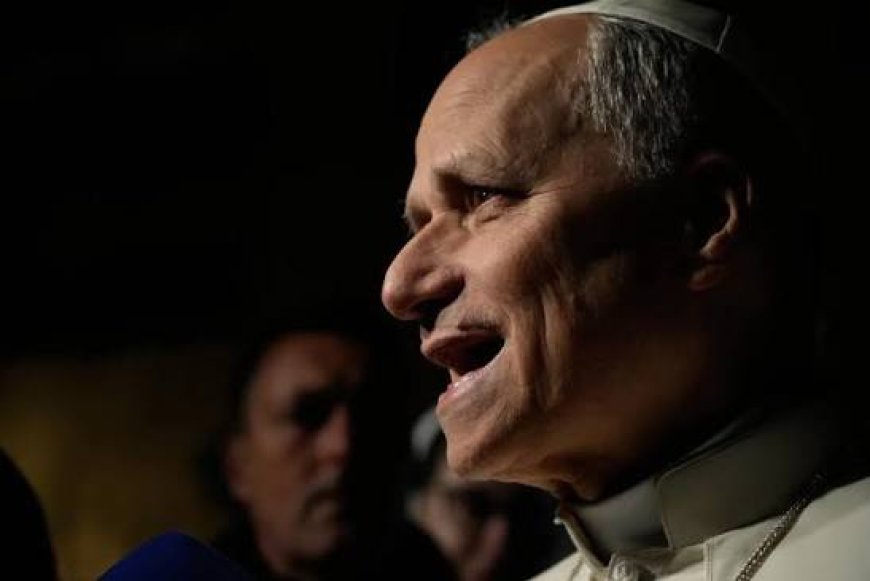
On his way back to the Vatican from Africa, Pope Leo XIV said justice, equality, political liberty and religious freedom for all people should take precedence over issues of sexual morality.
“I think it’s very important to understand that the unity or division of the church should not revolve around sexual matters,” he said on April 23. “We tend to think that when the church is talking about morality, that the only issue of morality is sexual,” the pontiff added.
Leo was answering a question about the new blessing of same-sex couples made by German Cardinal Reinhard Marx in Munich and Freising, which the Vatican’s doctrinal dicastery and the pope himself have opposed.
In his remarks on the papal plane, Leo said the Holy See had made clear to the German bishops that it does not agree with the “formalized blessing of couples,” including homosexual couples or couples in irregular situations, beyond what Pope Francis had permitted.
Leo was referring to Fiducia supplicans, the document issued by the Dicastery for the Doctrine of the Faith in 2023, under colour of which Marx and the German bishops have prepared their 2023 blessing guide and a recent supplement.
Fiducia supplicans was signed by Cardinal Victor Manuel Fernández but approved by Francis. The declaration caused controversy in the Church, with many dioceses and episcopal conferences refusing to accept it, especially in Africa, and the largest self-governing ritual Church in full communion with Rome publicly ignoring it.
Pope Francis eventually “clarified” his views on television.
“What I allowed was not to bless the union, that cannot be done because that is not the sacrament. But to bless each person, yes, the blessing is for everyone,” Francis later said in an interview with 60 Minutes, a program on the CBS network in the U.S.
The Vatican’s doctrine dicastery also recently posted to its website a Nov. 18, 2024, letter from Fernández to the German bishops in which the DDF head said the Germans were suggesting views contrary to Fiducia supplicans.
Fernández said Fiducia supplicans did not allow liturgical blessings that could “offer a form of moral legitimization” to the couples’ unions, while the German guidance included features proper to a marriage and “creates a type of liturgy or para-liturgy for the blessing of couples of the same sex.”
In remarks last week to Vatican Media, the cardinal said his 2024 letter still stands.
“What was said in that letter,” Fernández told Vatican News last week, “also applies to the text of the [Germans’] current Vademecum on same-sex blessings, which does not have the approval of the Congregation for the Doctrine of the Faith.”
That was some cold water, but same-sex advocates were not without their own reason to cheer last week.
Advocates for same-sex people in the Church were enthusiastic after the General Secretariat of the Synod of Bishops published a summary of one of the committees, which included a section on the experiences of people of faith with same-sex attractions.
“Other testimonies received by our Study Group from believers with same-sex attractions further confirm how arduous it is for individuals and Christian communities to reconcile ‘doctrinal firmness’ with ‘pastoral welcome’,” the document reads.
“These polarised positions, often deemed irreconcilable, result on one hand in profound suffering, personal lacerations, and experiences of marginalisation or ‘double lives’ for believers with same sex attractions,” the summary said.
“[O]n the other hand,” the document continued, “within the life of the Church, they trigger conflicts, oppositions, and seemingly incurable controversies between those who reaffirm non-negotiable principles in the name of truth and those who, albeit in different ways, emphasise the demands of understanding and merciful love.”
“These conflicts, though often hushed up, do not cease to be actively at work,” the General Secretariat’s summary also said.
“How can we get beyond this impasse?” asked the Synod office.
“If the Catholic Church has begun to listen to LGBTQ Catholics as part of its methodology, the church has already moved forward in a significant way,” wrote Jesuit Father James Martin.
Francis DeBernardo of New Ways Ministry wrote “this is the first time that the excerpts all point toward something positive and hopeful for the Church’s relationship with its LGBTQ+ members.”
If the summary document from the General Secretariat energized LGBTQ advocates, others remain dismayed.
Cardinal Gerhard Müller – who led the Vatican’s doctrine dicastery himself from 2012 to 2017 – said the study groups of the Synod of Bishops “do not openly deny the revealed truths,” but just ignore them and “build their own house of a comfortable and worldly-conforming Christianity alongside them.”
Müller also spoke directly about the ongoing controversy over the German plans.
“The private or even paraliturgical blessing of same-sex and opposite-sex couples in irregular relationships,” Müller said, “is based on the heretical denial of the revealed truth that God created human beings as man and woman.”
All the talk of the past week or so is now circling around one question: What does Pope Leo think about the issue?
The DDF is pushing against the German Bishops’ efforts to push forward on recognizing same-sex unions (which the Germans say is an embracement of the synodal process), while the Vatican’s own Synod office is publishing a document that seems supportive of some sort of accommodation for same-sex couples.
When asked about it, Leo seems to say he’d rather talk about other things. He may be biding his time, waiting for the temperature to come down. That is understandable, but time may be running out.
It is significant that Leo said “the Holy See” has clarified the matter for the German bishops, because it stresses the settled institutional position, but evidently that has not foreclosed the matter even inside the Vatican.
Senior churchmen are noticing, including the cardinal archbishop of Tokyo, Isao Kikuchi.
“[R]eal unity cannot be achieved by not taking any specific stands,” Kikuchi told Crux Now at the weekend, when Leo marked one year in office. “I expect Holy Father to make us see where he really stands,” Kikuchi said, ““and then, we may be able to begin dialoguing with people who have different opinions within the Church.”
Right now, Vatican departments are sending mixed signals. Sooner or later, Leo may have to give an answer.
What's Your Reaction?