












Alleged ₦110.4bn Kogi Fraud: Witness Narrates How Kogi State Internal Revenue Service paid over ₦1bn as commission to Philip Kumar
The trial of former Kogi State Governor, Yahaya Adoza Bello, continued on Friday, January 16, 2026, before Justice Maryanne Anineh of the Federal Capital Territory, FCT, High Court, Maitama, Abuja, with a prosecution witness narrating how the Kogi State Internal Revenue Service, KIRS, allegedly paid over ₦1.16 billion as “commission” into a Sterling Bank account belonging to one Philip Kumar within eight months in 2019.
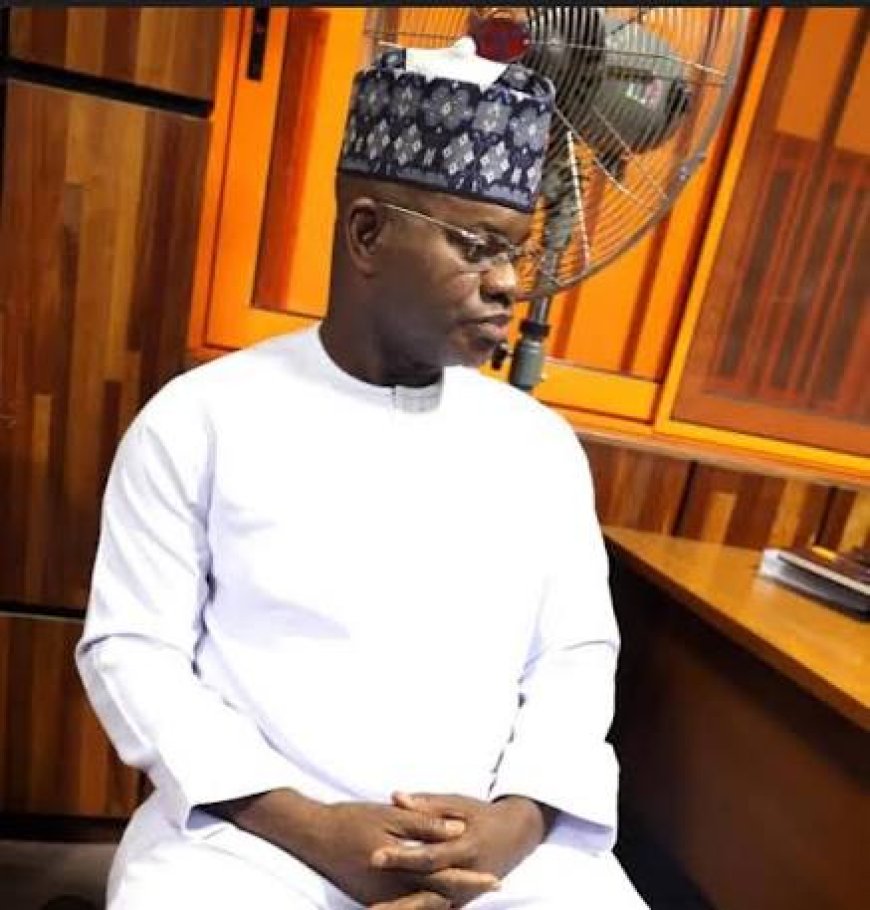
The trial of former Kogi State Governor, Yahaya Adoza Bello, continued on Friday, January 16, 2026, before Justice Maryanne Anineh of the Federal Capital Territory, FCT, High Court, Maitama, Abuja, with a prosecution witness narrating how the Kogi State Internal Revenue Service, KIRS, allegedly paid over ₦1.16 billion as “commission” into a Sterling Bank account belonging to one Philip Kumar within eight months in 2019.
The witness, Prosecution Witness 9, PW9, David Ajoma, a compliance officer with Sterling Bank, told the court that the payments, which spanned from January to August 2019, were followed by consistent and heavy cash withdrawals, a pattern he described as unusual based on banking standards.
Bello is standing trial alongside Umar Shuaibu Oricha and Abdulsalami Hudu on a 16-count charge bordering on criminal breach of trust and money laundering to the tune of an alleged ₦110.4 billion.
At the resumed proceedings on Friday, lead prosecution counsel, Kemi Pinheiro, SAN, informed the court that the matter was for the continuation of evidence by PW9, who appeared pursuant to a subpoena. The witness was then led in evidence by Pinheiro.
Pinheiro referred the witness to exhibit AD1, a statement of account earlier admitted in evidence, and drew his attention to transactions between March and August 2019. PW9 confirmed the transactions and, upon being asked to summarise inflows within that period, stated that a total of ₦963,803,717.38 was paid into the account from the Kogi State treasury.
When asked about withdrawals from the same account, the witness told the court that ₦835,904,000 was withdrawn in cash within the period under review.
Continuing, Pinheiro directed the witness to earlier entries on the statement of account, specifically inflows in January and February 2019. PW9 identified inflows of ₦99,593,761.81 on January 8, 2019, and ₦101,533,384.94 on February 7, 2019, both with narrations indicating Kogi State Internal Revenue Service.
Asked to do a cumulative summary of all payments made as “commission” from January to August 2019, the witness said: “From the exhibit, Kogi State Internal Revenue Service paid a total of ₦1,164,959,568.13 as commission within eight months in 2019.”
On total cash withdrawals between January and August 2019, PW9 told the court that ₦953,404,000 was withdrawn in cash.
Pinheiro further asked whether there was a consistent pattern of cash withdrawals on the account, to which the witness replied in the affirmative. He was also asked whether the withdrawals usually occurred shortly after inflows from Kogi State Government-related accounts.
“Yes, my Lord,” the witness answered.
The prosecution then asked PW9 to state the balance on the account as of December 31, 2018. He responded that the balance stood at ₦212,264.29.
Asked, as a banker, to give his professional opinion on the pattern of withdrawals, PW9 said: “As a banker, there is a consistent pattern of withdrawals.”
At this point, counsel to the 1st and 2nd defendants, J.B. Daudu, SAN, raised an objection, which Justice Anineh overruled.
The prosecution pressed further, asking the witness whether he was familiar with suspicious transactions in banking practice. PW9 answered in the affirmative. He was also asked to explain the concept of a Suspicious Transaction Report, STR, and relate it to the evidence before the court.
PW9 explained: “A suspicious transaction report is filed when a customer’s transaction pattern is not consistent with the nature of the customer’s business or previous transactions. In other words, it is filed for individuals who carry out cash transactions exceeding ₦5 million and ₦10 million for corporate entities, in line with CBN regulations.”
Asked about his findings from the statement of account, the witness said he observed “multiple cash withdrawals, with the maximum single withdrawal being ₦10 million.”
However, when asked whether Sterling Bank filed any STR in respect of the account, PW9 said he did not have that information readily available.
Pinheiro then directed the witness to examine the statement of account between July and December 2018, prior to the alleged commission inflows. PW9 confirmed that there were no inflows into the account between July and December 2018.
He also confirmed that during that period, cash withdrawals were minimal. According to him, withdrawals included ₦700,000 in July, ₦500,000 on July 4, ₦500,000 on July 12, ₦150,000 on August 17, ₦200,000 on September 13, and ₦1,000,000 on December 10, 2018.
When asked whether there was any withdrawal above ₦1 million within six months prior to the inflows from Kogi State Government accounts, the witness replied: “No, as seen from the statement of account.”
Pinheiro further asked whether the pattern of withdrawals between July and December 2018 was the same as that between January and August 2019.
“No, it was not the same,” the witness responded.
Explaining the earlier period, PW9 said withdrawals before January 2019 were largely online transfers, unlike the heavy cash withdrawals recorded in 2019.
Under cross-examination by J.B. Daudu, SAN, PW9 told the court that he had been with Sterling Bank for three years and was serving as a compliance officer, having joined the bank as an experienced hire.
Asked whether he had the account opening package for the account in question, the witness said he did not. He admitted that without the account opening documents, he could not identify the signatories, directors, or the nature of the business associated with the account.
He also agreed that he could not determine whether the business was seasonal or whether the transaction pattern was consistent with the customer’s line of business. He confirmed that his testimony was limited strictly to the contents of Exhibit AD1.
Daudu further asked him to confirm the narration of the inflows identified as coming from Kogi State Government or KIRS. PW9 said the narrations indicated “Kogi State transfer” and “KIRS transfer,” but added: “I do not know what it means.”
On February 2, 2019, the witness said the narration read “commission for January 2019 – Kogi State Internal Revenue Service.” He admitted he did not know the difference between Kogi State Government and Kogi State Internal Revenue Service.
He further agreed that he could not tell whether the funds belonged to the customer or how the customer chose to spend them, whether by cash withdrawal or online transfer. He also confirmed that there was no record before him showing when the business relationship between Kogi State Government and the account holder commenced.
According to him, “When there is money, there will be consistent withdrawal; when there is no money, there will be consistent no withdrawal.”
When asked whether all the inflows were withdrawn solely by Philip Kumar or if there were other beneficiaries, the witness said the focus was mainly on Kumar but admitted that there were other beneficiaries. He cited an instance on January 8, 2019, where ₦2.5 million was transferred with the narration “Visco Business Solution / Ayodele Adedipe.”
PW9 further stated that he did not know the 1st defendant and had never seen any of the defendants before.
Counsel to the 3rd defendant, A.M. Aliyu, SAN, also cross-examined the witness.
With no further questions from counsel, Justice Anineh discharged PW9 from the witness box and adjourned the matter to February 10 and 11, as well as March 11 and 12, 2026, for continuation of trial.
What's Your Reaction?