






















Osun Elections: Connecting the Dot in Matters Arising
The ballot boxes are empty after the voters have spoken. Will Nigeria listen? The votes have been counted. The results have been declared.

By Prof Chris Agbedo
The ballot boxes are empty after the voters have spoken. Will Nigeria listen? The votes have been counted. The results have been declared. Governor Ademola Adeleke has been returned for another term, defeating APC candidate Bola Oyebamiji with 511,067 votes against 444,815 and winning 19 of Osun's 30 Local Government Areas. The immediate political arithmetic is clear. The larger meaning is not. Osun has produced a political picture in which an armada of 16 APC governors and the formidable machinery of the ruling party could not deliver the state. The Accord Party won convincingly. That is the first dot. Political power is not necessarily electoral power. Sixteen governors cannot vote at every polling unit. Presidential influence cannot enter every ballot box. A political convoy cannot substitute for a voter. The Osun electorate has reminded Nigeria of something the political class repeatedly forgets: The ballot can still surprise power.
The second dot is more profound. Osun voters did not merely cast ballots. They reportedly confronted intimidation, resisted attempts to disrupt the process and insisted on exercising their franchise despite an extraordinarily heavy security presence. Some reportedly stood up to soldiers. That should neither be romanticised nor trivialised. Citizens should not attack security personnel. Soldiers and police officers have legitimate responsibilities in securing elections. But there is a constitutional line that must remain inviolable: The security forces protect the voter; they do not become the voter's political master. The reports of citizens standing their ground therefore speak to something fundamental about democracy. The ballot survives when citizens insist on their right to use it. Some Osun citizens reportedly paid an even heavier price. Reports of election-related violence and deaths during the electoral period should not disappear beneath the celebration of victory. Those who defended the vote deserve to be remembered. And those who lost their lives in the process deserve more than a footnote in somebody's victory speech.
Then came the fish, the rice and the vote. Another remarkable image emerged after the election in a viral video aired by AIT. People were celebrating the Accord victory. One person reportedly said, with unmistakable humour, that he collected APC money, used it to buy tilapia, and still voted Accord. Another thanked the APC for the rice it distributed; he cooked it; ate it; gained the energy from the meal and went to the polling booth to vote for Accord. The stories are amusing.
The underlying message is serious. Vote buying is unlawful and corrosive. It should never be normalised as democratic behaviour. But the episodes expose an equally important political reality: The politician can buy access to the voter without buying the voter's conscience. The cash can change hands. The rice can enter the cooking pot. The tilapia can enter the frying pan. The meal can enter the stomach. But the ballot remains behind the curtain. That is the weakness of vote buying as an instrument of electoral control. The politician assumes: “I gave you money; therefore you owe me your vote.” The voter may reason: “You gave me money because you needed my vote.” Those are entirely different transactions. The AIT footage should therefore not be read as an endorsement of vote buying. It is better understood as a demonstration of the limits of the political class's assumption that poverty automatically translates into political obedience.
The voter may be economically vulnerable without being politically naïve. The voter may accept inducement without surrendering electoral choice. The voter may eat the rice and reject the political recipe. That is precisely why the secret ballot remains so important. You can purchase a meal. You cannot reliably purchase a conscience. The APC bought the rice; the voter retained the recipe.
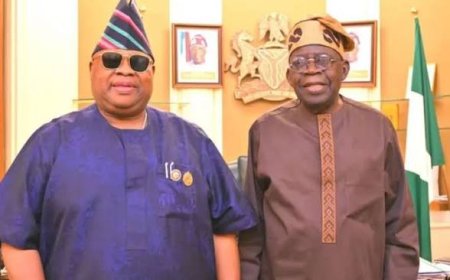
And now the curious case of Adeleke’s gratitude. This brings us to another dot that is considerably less amusing. One might have expected the re-elected governor to stand before the people of Osun and say: “You voted for me. You defended your votes. This victory belongs to you.” Instead, Governor Adeleke quickly reaffirmed his support for President Bola Tinubu’s 2027 re-election bid, describing Tinubu as a fellow Yoruba and “son of Osun.” There is nothing constitutionally wrong with Adeleke choosing to support Tinubu. But politically, the timing raises difficult questions. The Osun electorate has just defeated the candidate of Tinubu’s ruling party. The same electorate has demonstrated that it can distinguish between its governorship preference and its presidential preference. However, the governor it has just re-elected is openly aligning himself with the President for 2027. That is where personal political interest and electoral mandate appear to collide. It would be speculative to claim that Adeleke made a secret bargain with Tinubu to protect his victory from possible judicial intervention. There is no reliable evidence before us establishing such an arrangement. But the subsequent exchange between Aviation Minister, Festus Keyamo and Adeleke’s camp has made the political optics even more curious. Responding to Adeleke’s endorsement, Keyamo declared: “Agreement is agreement.” The governor’s Imole Campaign Council promptly replied: “There is no agreement.” That brief political ding-dong does not establish that any agreement existed; Adeleke’s camp has expressly denied it. But it inevitably deepens the question surrounding the governor’s unusually warm post-election “thank you” to a President whose party had just been defeated in Osun. If there was no agreement, what exactly was Keyamo referring to? And if the minister’s remark was merely political banter, why did it so readily evoke the suspicion of a bargain?
The issue, therefore, is not to manufacture an agreement where none has been established. It is to recognise that political ambiguity itself can become a matter of public concern when it follows so closely upon an electoral mandate. Is Adeleke merely being politically pragmatic? Is he seeking a productive relationship with the Federal Government? Is he positioning himself for 2027? Or has the personal political calculus begun to overshadow the electorate that gave him the mandate? The question is unavoidable because the mandate does not belong to Adeleke. It belongs to the people of Osun. And therein lies the larger democratic lesson. A governor may exercise his constitutional freedom to choose whom to support politically. But an electoral mandate is not a personal political asset to be redeployed at will; it is a public trust. The people may forgive political pragmatism. What they should never be asked to surrender is the right to know when the political choices made in their name begin to serve interests beyond the mandate they freely conferred.
Then, Tinubu's response to Adeleke's victory provides a more encouraging dot. He congratulated the governor and accepted the result as an expression of the people's will. That is how democratic politics should work. The President had told Osun voters before the election to vote for the candidate of their choice without fear. They did. They chose Adeleke. The President congratulated him. The democratic grammar is coherent: Let the people vote. Let the people choose. Accept their choice. That principle becomes even more important as Nigeria approaches 2027.
The next dot connects APC’s Look into the mirror. The APC's own post-election diagnosis is revealing. Party chieftain Farouk Aliyu attributed the defeat to internal wrangling and complacency, saying the party had effectively “defeated itself” and warning against taking voters for granted. That admission may be one of the most important lessons of Osun. Never take the voter for granted. Not even when you control the Federal Government. Not even when 16 governors campaign for you. Not even when money changes hands. Not even when political machinery appears overwhelming. The voter can listen to your speech, collect your rice, eat your tilapia and still walk into the polling booth carrying a different political decision. That is democracy's inconvenient little secret.
And now, INEC, the referee that matters. INEC occupies an important dot in this picture. The Commission declared Adeleke the winner, while its IReV system transmitted a substantial proportion of polling-unit results during the collation process. The process was not without problems; reports included delays, BVAS difficulties, allegations of vote buying and isolated violence. But one lesson remains clear: Electoral credibility is built one election at a time. INEC must improve logistics, technology, result management, voter access and communication before 2027 such that independent elections wouldn’t need to be compelled to start releasing results from their own servers. The Commission can transmit results. It cannot cure political corruption. It can accredit voters. It cannot manufacture political morality. It can declare a winner. It cannot make politicians democratic. That responsibility belongs to the entire political ecosystem.
The 2027 Dot
Osun should therefore be read as more than a governorship election. It is a warning shot for 2027.
Federal power has limits. Political armadas have limits. Money has limits. Intimidation has limits.
Even incumbency has limits. The voter remains the variable that can upset every political calculation. This connects directly with the Governance Optimality Theory lens. A political system generates competing candidates and outcomes, while its dominant constraints determine what ultimately survives. If the higher-ranking constraints are money, intimidation, violence, patronage, religious manipulation and impunity, the system may produce what we have called an Optimised Failure, a winner produced by a defective political hierarchy. Osun offered a different possibility. The electorate elevated choice, participation and the secret ballot above the political armada. The voter became the constraint that power had to respect. That is the real lesson.
The Final Dot
Osun has demonstrated that democracy is not merely what politicians do to voters. It is what voters can do to politicians. They can reject a party with 16 governors behind it (including one backed by imported thugs). They can resist intimidation. They can defend their votes. They can expose the limits of vote buying. They can distinguish between candidates and elections. They can surprise the powerful. But politicians must also learn their own lessons. The APC must learn that complacency is expensive. INEC must learn that credibility requires constant improvement.
Security agencies must learn that protecting elections means protecting voters, not intimidating them. And Adeleke must remember that the people of Osun, not Abuja, gave him his mandate. He should thank them accordingly. Because the rice has been eaten. The tilapia has been digested.
The political money (N6 Billion allegedly) has been spent. The campaign convoys have gone. The governors have returned home. What remains is the ballot. And behind that ballot is a citizen, who has discovered something profoundly democratic: Power may influence the election; but the voter still owns the final word. That is the dot Nigeria should carry from Osun into 2027.
What's Your Reaction?