




































For All Nigerians Interested Interested In A Free And Fair Election In 2027: IREV And Real-Time Result Transmission
The Electoral Act (Repeal and Re-enactment) Bill 2025 has been referred to the Conference Committee of the Senate and the House of Representatives.
By Festus Okoye
The Electoral Act (Repeal and Re-enactment) Bill 2025 has been referred to the Conference Committee of the Senate and the House of Representatives. The Conference Committee will harmonise the bill and agree on a single bill for concurrence by both chambers.
Both chambers passed different versions of the bill, and committee members are expected to draw on their collective experience to guide the reconciliation process and achieve a clear legislative outcome. The establishment of the Conference Committee indicates that work on the bill is nearing completion.
Nigerians are expecting a bill to improve election conduct. Some issues may arise during their deliberations that none of the chambers has previously addressed, and they are expected to draw on their diverse experiences to resolve these.
However, three key issues in the reconciliation process can help ensure a good election, improve the electoral process and electoral accountability, and guarantee free, fair, and transparent elections. The first issue concerns the live transmission of election results from polling stations.
The second relates to election timelines, while the third involves political party membership registers and the organisation of primaries, congresses, and conventions. Of these, the live transmission of results has been particularly contentious and has provoked strong emotions.
Election timelines, membership registers, and the organisation of primaries, congresses, and conventions must also be managed carefully, following the Commission’s release on February 13, 2026 of the Timetable and Schedule of Activities for the 2027 General Election.
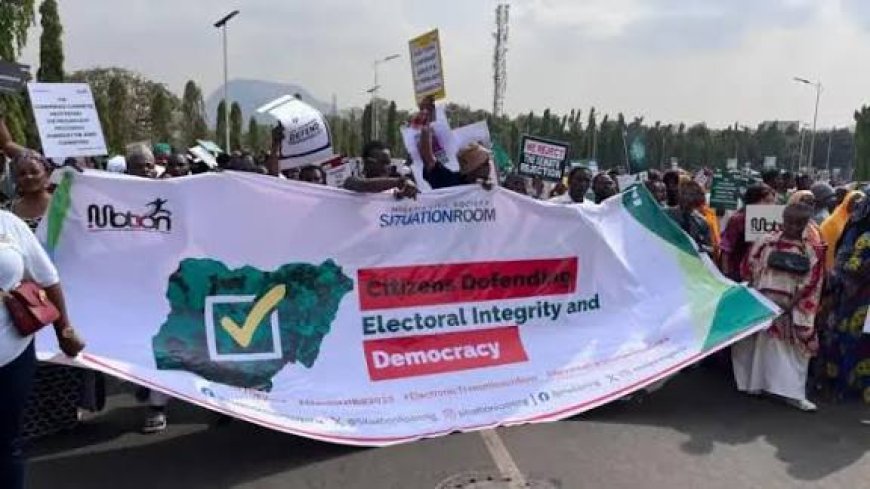
Hence, the debate, demonstrations, anger, name-calling, denials, and clarifications surrounding certain provisions in the Electoral Act (Repeal and Re-enactment) Bill 2025 are part of the legislative process in a democratic society.
It demonstrates that Nigerians are attentive to issues and committed to strengthening democracy and the electoral process. It also emphasises that lawmaking cannot always be conducted in secret, as the National Assembly is the voice of the people, and its deliberations, processes, and procedures must be sensitive to the feelings and views of the Nigerian populace.
The reconvening of the Senate of the Federal Republic of Nigeria on February 10, 2026, ostensibly to approve the votes and proceedings but more importantly to respond to public outcry over the rejection or deletion of real-time electronic transmission of results, is in itself a victory for democracy and the Nigerian people.
It demonstrates that democracy is about the people, and democracy will decline when the people withdraw from it or no longer pay attention to what is happening in the polity. The Senate met and reconsidered its stance on the electronic transmission of results, forming its own 12-member Conference or Harmonisation Committee.
The Committee will hold joint discussions with the House of Representatives Committee to reach an agreement on the final version of the bill. Subsequently, both Houses will pass the bill and send it to the President of the Federal Republic of Nigeria for assent.
What did the Senate ultimately pass and agree upon regarding real-time transmission of results? Has the Senate’s new stance and the version approved by the House of Representatives altered the landscape for result transmission and collation?
Aside from election timelines, political party membership registers, and the organisation of primaries, congresses, and conventions, are there other relevant issues the Conference Committee needs to address to establish a sound electoral legal framework that guarantees transparent elections?
Will the law’s passage, as advocated by most civil society groups and organisations, automatically ensure free, fair, and transparent elections?
The Conference Committee must ensure that any legislation they approve and pass to both Houses of the National Assembly complies with the constitution. In other words, they must acknowledge The Supreme Court of Nigeria, the highest court in the land, clearly and unambiguously stated that the INEC Results Viewing portal is not a collation system; that the Constitution of the Federal Republic of Nigeria is the supreme law of the land, and all other laws must conform to the Constitution. As Hon. Justice J JAURO, JSC, highlighted in NPF & Ors V. POLICE SERVICE COMMISSION & Anor, the Constitution of the Federal Republic of Nigeria is the grundnorm, the fundamental law of the land. It overrides any other law or instrument enacted by the National Assembly, State House of Assembly, or any other person or authority empowered in this regard. It is from the constitution that all other laws or instruments derive their validity and binding force.
The Conference Committee must use clear, unambiguous language, particularly regarding the contentious issue of result transmission. The Committee should avoid relying on assumptions or giving credence to populist appeals.
They stand at a pivotal moment in history, and whatever they recommend could shape Nigerians’ perception of the conduct and outcome of the 2027 general election. The Committee will address two interconnected issues that may cause confusion and doubt among Nigerians.
The first concerns the version of section 60(3) passed by the House of Representatives and the version ultimately endorsed by the Senate.
The version passed by the House of Representatives reads: “The Presiding Officer shall electronically transmit the results from each polling unit to the IREV portal in real time, and such transmission shall be done after the prescribed Form EC8A has been signed and stamped by the Presiding Officer and/or countersigned by the candidates or polling agents where available at the polling unit.”
Conversely, the version approved by the Senate states: “Results shall be transmitted electronically from each polling unit to the IReV after the prescribed EC8A has been signed and stamped by the presiding officer and party agents who are available at the polling unit.
“Provided that where the electronic transmission of the result fails as a result of communication failure, the result contained in form EC8A signed by the presiding officer and/or countersigned by polling agents shall, in such a case, be the primary source for collation and declaration of results.”
Initially, the version approved by the House of Representatives appears more progressive, as it includes mandatory provisions like real-time transmission of results and lacks the negative clause that suggests electronic transmission is uncertain and might fail due to cyber security issues or deliberate human interference.
*Unfortunately, the version approved by both chambers of the National Assembly does not specify the electronic transmission of results for collation.* *Both chambers only require the electronic transmission of results to the INEC Result Viewing Portal for public viewing, NOT for collation.*
The proviso in the version passed by the Senate is misleading and creates a false impression that the results transmitted to the INEC Result Viewing Portal will be used for collation. The Supreme Court of Nigeria, the highest court in the land, clearly and unambiguously stated that the INEC Results Viewing portal is not a collation system.
They opined that, as their names suggest, the Collation System and the INEC Result Viewing Portal, IReV, are part of the election process and serve distinct but complementary roles.
*The Collation System includes the centres where results are collated at various stages of the election.
*The results transmitted from the polling units to the collation system provide the relevant collation officer with the means to verify a polling unit result as needed for collation. The results transmitted to the Result Viewing Portal are to give the public at large the opportunity to view the polling unit results on election day.
*To transmit results electronically in real time for collation, the Independent National Electoral Commission must establish a collation system that enables polling stations to send their results directly.
*Therefore, the entire debate over section 60(3) of the Bill is a storm in a teacup, and the Senate’s proviso to section 60(3) effectively legalises electoral malfeasance disguised as technology.
*“To enable real-time electronic result transmission, INEC must establish a collation system that receives results electronically and processes them immediately.”
The results sent to the IREV will stay unchanged for public viewing and accountability.
The proviso to section 60(3) should also be removed, with provisions introduced to ensure that manual and electronic results align.
In case of any discrepancy, the electronically transmitted result should take precedence. Can this be achieved before the presidential election scheduled for February 20, 2027?
**Festus Okoye is former INEC Spokesperson
What's Your Reaction?