



















Does the Opposition really want Tinubu Out?
It's obvious in politics, as in every human endeavour, that a house divided against itself cannot stand.
Political Musing of Thursday, August 20, 2027
By Ike Abonyi.
_"A fragmented opposition turns democracy into a spectator sport where the governing party dictates the rules, the score, and the outcome" —Comparative Politics Commentary.
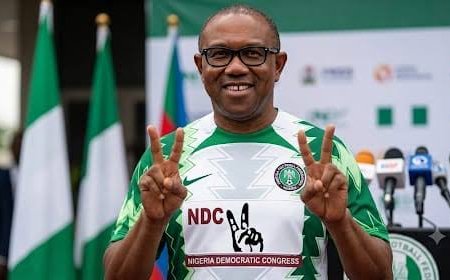
Everybody expects an obvious "yes" answer to the above question but has no agreeable answer to the follow-up questions, which are: ‘Is the opposition realistically working toward dethroning Tinubu, or can they achieve removing Tinubu, divided?’ It's obvious in politics, as in every human endeavour, that a house divided against itself cannot stand. In a political commentary, a modern spin on institutional paralysis caused by extreme partisanship was asserted: "A house divided against itself cannot stand, but it can make a lot of noise while it's falling." Is that not exactly what opposition politicians are doing in Nigeria? The noise of Atiku Abubakar and Peter Obi on why Bola Tinubu should be removed is overwhelming and on the rooftops, but can noise alone remove an undesirable holder of the throne who already publicly states that everything is fair in politics? The last time similar noise was raised to bring down the house in this country, and it achieved its aim, was in 2014. However, the noise then was backed by action anchored in unity and the sacrifice of the key gladiators. Does such exist today? Can the G100 group achieve it? How sincere and realistic are the G100? Many political watchers do not give them a good chance to achieve anything due to certain existing variables, including sincerity. If the G100 move fails in uniting the candidates as it'sbeing projected, does that translate into an easy victory for Tinubu? Certainly not, because the aggrieved voters who have been at the receiving end of Tinubu’s disastrous reign can decide to make history by saying no to politicians and may decide to end the bazaar by forming their own opposition bloc. Does that sound unrealistic, given the docile nature of Nigerian youths towards political issues? Yes, but not impossible, since everything that has a beginning equally has an end. Has Nigeria not suffered enough in the hands of corrupt politicians to say no to ethnic and religious bigots? The obvious answer is in the affirmative. January 16, 2027, the day already set out in history (exactly 150 days from today), will determine the outcome. While it seems real that, ahead of the crucial 2027 presidential election, all the ruling All Progressives Congress, APC, need to remain in power is to keep the opposition divided; its glaring misrule is also helping the people to remain united against them despite the politicians' division. When it came to power in 2015, all the APC did was keep the then-ruling party, the People's Democratic Party, PDP, divided. Then they were not in power; now they are not only in power but Bola Tinubu, the chief coach of the game in 2014, is on the throne as a referee for the next match, while Mallam Nasir El-Rufai, who was Tinubu's deputy architect in the game then and who should have been on the sidelines helping the opposition technically in unveiling the tactics, unwisely played into Tinubu’s hand by mishandling his anger and his freedom to find himself in custody that may deny him access to the next game. Today, he is at the mercy of Tinubu's agencies and the court to even have access to his family. Sadly, after twelve years in opposition rather than uniting to challenge the APC—which, luckily for them, has been disastrous in office—the opposition politicians have remained endlessly divided. For the ruling APC, rather than dividing, they have even expanded, consolidating their base fraudulently from control of 21 states in 2023 to 31 in 2026. This has resulted not necessarily from the ruling politicians' ingenuity but largely due to the greed and self-service of Nigerian politicians, whose unwillingness to make sacrifices or recognise when the ovation is not for them is glaring. Nevertheless, it remains worrisome that amid the rising political strength of the ruling party from 21 to 31 out of 36 state governors, the first time in Nigeria that a ruling party is in such overwhelming control of electoral structures, the organic support enjoyed by Peter Obi remains unpredictable after he entered the electoral system in 2023 without a single state governor, national or state legislators, nor local government officials, and still managed surprises, winning some states, including Lagos and Abuja. Consequently, even though the opposition refuses to unite and goes into the battle piecemeal and disjointedly, the ruling party is still in a panic mood over Obi. The truth is that even with such an electoral structure, the ruling APC's public image is very diminished, in such a way that could reflect in the ballot come 2027. What is not in doubt is that only a united and forthright opposition can turn the tables—especially when they cannot match the electoral corruption that the ruling party is ready to deploy blatantly. The last time the opposition turned the tables in Nigeria's polity, sacking a ruling government, was in 2015, when the then-ruling PDP, led by President Goodluck Jonathan, was defeated by a united opposition under the APC, CpC, ACN, and factions of APGA and PDP. The defeat was facilitated by then-referee Jonathan, who desired fair play and wished to avoid bloodshed for his ambition. Today, the opposition relies on Peter Obi and Rabiu Kwankwaso, who carry the wave of opposition in a new party, the Nigeria Democratic Party (NDC), with their organic groups, the Obidients and Kwankwassiya, now structured as the O.K. Group, to do the magic. No local government chairman or governor is among them, but they carry a significant portion of Nigerians. The former Vice President Atiku Abubakar and his running mate, Rotimi Amaechi of the African Democratic Congress (ADC), who were part of the 2015 successful rebellion that toppled their own then-ruling PDP, are also involved today, but they do not enjoy the same leverage as in 2015, when opposition was united, and the ruling PDP was divided and not favoured by political zoning. Today, Atiku and his group, as Northerners, are working against the tide because the presidency is zoned to the South until 2031. While zoning is not statutory, it has been politically binding since the Second Republic. The disruption of zoning after President Yar'Adua's death in 2020 was quickly restored in 2015. For an opposition alliance to succeed today, it must heed lessons from the 2014 APC merger, which required three elements: sacrifice of top ambitions (key principals accepting non-presidential roles or enforceable single-term pacts), outright party mergers with formal structures rather than loose election-year pacts, and a clear, programmatic alternative to the incumbent’s policies that give voters a compelling reason beyond merely removing the ruling party. Equally critical is Obi’s willingness to accept a one-term sacrifice in respect of zoning, and Kwankwaso’s willingness to settle for a running mate to a southerner in respect of zoning, which is significant. The consequences of opposition's lack of unity, if unchecked, extend far beyond electoral loss.' They actively degrade our democracy: when voters realise that their preferred candidate has no realistic path to victory without a unified coalition, voter apathy sets in. Why stand in line for hours under the sun when you know the anti-incumbent vote will be hopelessly fragmented? This voter fatigue erodes turnout, further insulating the ruling party from true accountability. Moreover, a fragmented opposition yields a fragmented legislature. Without a cohesive, organised opposition bloc in the National Assembly, as seen with the Godswill Akpabio-led legislature, the executive branch operates virtually unchecked. Alternative policy proposals are never fully developed, rigorous oversight fades, and Nigeria slips further into de facto one-party dominance—not by law, but by opposition default. Summing up this conversation, I like to bring in a contemporary political science maxim that “Democracy requires consensus, and consensus requires compromise. When partisan identity overrides civic duty, the house doesn't just divide—it collapses.” Sad. God help us.
What's Your Reaction?