












Another Four Years of Tinubu: A Nightmare Never to Be Contemplated
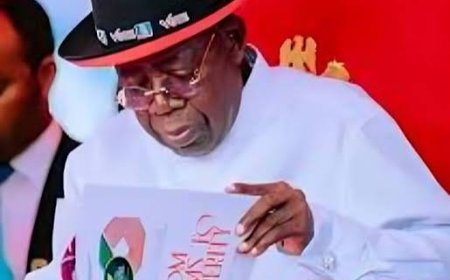
When the chants of "Ba mayii" and "Tinubu Must Go" resound throughout the country, they reflect the spontaneous response of citizens who cannot envision President Bola Tinubu remaining in office for another four years.
Political Musing of Thursday November 19, 2026
By Ike Abonyi.
" Failing to reject poor rule invites consequences" Mehmet Murat_ Ildan.
When the chants of "Ba mayii" and "Tinubu Must Go" resound throughout the country, they reflect the spontaneous response of citizens who cannot envision President Bola Tinubu remaining in office for another four years. Regardless of the factors shaping your political views and electoral conduct ahead of Nigeria's crucial January 16, 2027, Presidential election—whether ethnicity, religion, appointment or loyalty to a political party—I urge you to pause and consider what another four years under a Tinubu Presidency would mean for Nigeria. Such a prospect would not represent continuity alone. It would likely intensify the conditions Nigerians have experienced since 2023: the severe cost-of-living crisis, the erosion of public confidence, the growing acceptance of violence as normal, and the blatant diversion of public wealth, all of which could persist and expand. The central question would not simply be whether Nigerians could withstand another four years of hardship. It would be what kind of nation would remain at the end of that period. Democracy could be further weakened as public institutions lose more of their independence, political accountability declines, and citizens become increasingly discouraged by the belief that their votes have little effect on the direction of government. Rather than serving as meaningful expressions of public choice, elections will become ceremonial events that leave citizens detached from political power. Democracy will be incapacitated. This will not constitute governance. It will be theatre: an extended, carefully staged production in which the nation itself lies on the operating table, while the surgeons are the same individuals who benefit from its decline.Tinubu's arduous first term taught Nigerians a harsh lesson: suffering is not an unintended consequence of reform but reform's defining reality. The fuel subsidy was eliminated overnight without safeguards, preparation, or compassion. The naira was floated and left to sink. Electricity rates increased while darkness persisted. Food inflation transformed garri, rice, beans, and yam — staples for the poor — into unaffordable luxuries. Another four years will finish what the first began: pricing ordinary life beyond the reach of most people.Wages will remain frozen as transportation, rent, school fees, and medication costs rise again, potentially doubling. The middle class, already reduced to a fragile remnant, will finally collapse. The poor will face more than poverty; poverty will pursue them relentlessly, forcing impossible choices between feeding a child and treating an ill parent, or sending a child to school and paying for shelter. Poverty will expand, not because Nigeria is without wealth, but because that wealth will continue to be intentionally redirected upward — taken from millions of struggling families and funnelled to a small network of contractors, cronies, oil cabals, and political godchildren.Democracy under Tinubu has already been reduced to a hollow ritual — elections are announced, outcomes predetermined, courts treated as rubber stamps, and opposition figures intimidated, purchased, or destroyed. With incumbency firmly entrenched and the electoral commission, security agencies, and judiciary already captured, elections will amount to little more than coronations. Voter apathy will grow as citizens absorb the lesson: their votes do not count, their voices carry no weight, and protests will be answered with tear gas, arrests, or bullets. The National Assembly will remain what it has become — an extension of the Presidential Villa, approving loans, budgets, and appointments without meaningful scrutiny. Governors will be kept compliant through federal allocations and EFCC threats. The press will censor itself, while those who refuse will face raids, detention, or financial ruin through lawsuits.Democracy will continue to be invoked in speeches. It will no longer exist in practice.Nigeria is already experiencing a form of insecurity so pervasive that it has become horrifyingly routine: ransom kidnappings in Abuja and Kaduna, banditry throughout the Northwest, terrorism in the Northeast, clashes between farmers and herders in the Middle Belt, separatist violence in the Southeast, and cult activity and armed robbery in the South. Over the next four years, insecurity will expand further because it has developed into an industry. Billions will still be allocated to defence, and billions will still disappear. Generals will accumulate greater wealth while frontline soldiers remain without adequate equipment, morale, or pay. Kidnapping will become even more commercialised—a levy that every Nigerian household must pay to move, travel, and live.The state will not fail to protect Nigerians because it lacks the capacity to do so. It will fail because a secure Nigeria is less profitable than a fearful one. Fear keeps citizens distracted, divided, and eager for a strongman. If the first term represented corruption conducted discreetly, the second will bring corruption into the open. Freed from the pressure of reelection and facing no meaningful opposition, those responsible for looting will act without restraint. Contracts will be inflated to extraordinary levels. The oil industry, the refineries, customs, the NNPC, and the CBN will all be treated as personal ATMs. Inflated budgets, nonexistent constituency projects, and relief measures that never reach the public will all increase. Anti-corruption bodies will continue to function as instruments of power rather than independent watchdogs: unleashed against opponents and lenient toward allies. Those who steal while carrying the right party credentials will remain beyond accountability, while anyone who challenges the system will face investigation. Impunity will deepen because it will have been rewarded. When a minister embroiled in scandal is merely reassigned instead of dismissed; when a governor who rigged an election is rewarded with a ministerial appointment; when a security chief who failed is promoted—the message is unmistakable: in Tinubu’s Nigeria, loyalty can make crime profitable.And so, God forbid, after another four years under this regime, Nigeria will be taken into an operating room. This will not be a theatre for culture or art, but a surgical theatre where the operation proceeds without anaesthesia. Nigeria, the patient, will lie powerless as the operators cut, stitch, and extract, while assuring the family outside that the procedure is succeeding. The world will watch as a giant nation—Africa’s most populous country and, in potential, its largest economy—is reduced to pleading for loans, food aid, and the patience of its own citizens who are seeking to japa. Within the theatre, the lights will remain on, the cameras will continue to record, and the president will smile, cut ribbons, commission projects that will not function, and announce reforms that will only inflict further hardship. Outside, Nigerians will be lining up for fuel, food, visas, and the means to survive. The next four years would not merely extend the status quo. They would deepen it, make it harsher, and entrench it more firmly. They could mark the point at which suffering ceases to be temporary and becomes the governing order itself—when democracy, security, and justice are not only eroded but declared dead on the operating table, while those responsible for their destruction pose for photographs beside the remains. Consider a country in which suffering is normalised, insecurity is an ordinary presence, corruption is shielded by political power, impunity is embedded in institutional practice, and poverty continues to consume the aspirations of one generation after another.
This is the risk of permitting unresolved national crises to become entrenched in the system of governance. Nigeria is not a patient to be kept indefinitely on life support; it is a nation requiring immediate institutional, economic, and security intervention. The country must not be forced into an emergency operating theatre because its institutions have deteriorated beyond recovery. The moment to implement essential reforms, rebuild public trust, reinforce democracy, and protect the nation is now. Four additional years must not amount merely to four more years in office. They must produce tangible improvements in the lives of Nigerians. As the current administration seeks another mandate, its record, commitments, and ability to confront these challenges must remain subject to public scrutiny. Nigeria's future is far too important to be determined by political expediency.
What's Your Reaction?