





































The Missing Files Must Be Found
A good political cartoon does not merely make us laugh. It makes us look twice. A great one makes us laugh first, then wonder whether we should have laughed at all.
A good political cartoon does not merely make us laugh. It makes us look twice. A great one makes us laugh first, then wonder whether we should have laughed at all.
This cartoon achieves precisely that unsettling transition.
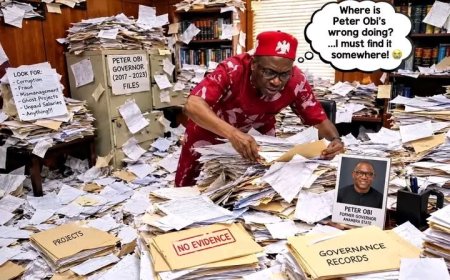
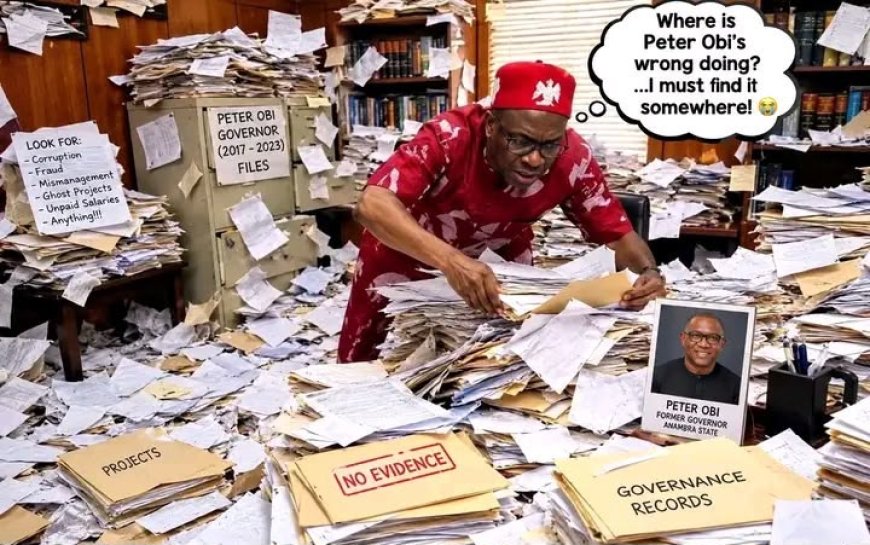
Its visual grammar is deceptively simple: a politician rummages through an avalanche of files in search of evidence about Peter Obi’s administration as former governor of Anambra State. Around him are folders labelled “Projects,” “Governance Records,” “Peter Obi Former Governor (2017–2023) Files,” and a conspicuously stamped “NO EVIDENCE.” Another notice announces the items allegedly being sought: “Corruption,” “Fraud,” “Mismanagement,” “Ghost Projects,” “Unpaid Salaries” and “Anything!!!” The thought bubble supplies the punchline: “Where is Peter Obi’s wrongdoing? …I must find it somewhere!”
The cartoon’s real subject, however, is not merely Peter Obi. It is the politics of searching for evidence after deciding what the evidence must prove. Let’s enlist the analytical proboscis of some humour theories in locating the missing files.
*The Incongruity Theory*
The joke begins where the scene doesn’t make sense.
Humour emerges when our expectations collide with something that violates them. A political investigator searching for wrongdoing should presumably encounter documents that establish wrongdoing. Instead, the cartoon gives us the reverse: mountains of paperwork but no incriminating discovery.
The visual contradiction is delicious.
There is an almost absurd excess of evidence surrounding an apparent absence of evidence.
The cartoon therefore converts absence into the central visual object. “No evidence” becomes the most conspicuous file in the room.
That is clever cartooning.
The drawer is full; the allegation is empty.
*Benign Violation Theory*
Accusation becomes comic because the violation is contained.
The cartoon deals with a potentially serious subject—political corruption and the search for official wrongdoing—but places it inside an exaggerated, almost theatrical environment.
The violation is the insinuation that someone may be desperately searching for wrongdoing that cannot be found.
The benignity comes from the cartoon’s absurdity.
Nobody is actually conducting an investigation in this paper jungle. The impossible mountain of files transforms an otherwise serious accusation into comic theatre.
That is where the cartoon becomes satirical rather than merely accusatory.
Its message is effectively:
If you have already decided that someone must be guilty, perhaps the investigation becomes a search for confirmation rather than a search for truth.
The humour lies in the inversion.
*Superiority Theory*
The audience gets to see the absurdity.
The viewer occupies a privileged position. We can see the entire room at once. The character cannot.
He is bent over the papers, desperately searching.
We, the audience, see the joke before he does.
That visual arrangement creates the classic superiority effect: the spectator knows something the character does not know.
He searches beneath one pile while the cartoon has already shown us the enormous folder marked “NO EVIDENCE.”
The joke therefore depends upon dramatic irony.
The investigator is looking everywhere except where the cartoonist wants us to look.
*Relief Theory*
Laughter releases political tension. Political allegations are rarely neutral subjects. They carry reputational consequences, partisan emotions and public anxiety. Humour provides psychological release by converting a potentially explosive political dispute into an exaggerated visual performance.
The audience laughs because the cartoon gives form to something that political discourse often leaves abstract: the frustration of searching for proof. The mountain of paper becomes the pressure valve.
But the most important brushstroke is satire.
The deeper mechanism, however, is satirical reversal.
The cartoon reverses the normal logic of investigation:
Evidence → conclusion
becomes
Conclusion → search for evidence.
That distinction matters.
A legitimate evidentiary process begins with an allegation that must be tested against independently verifiable facts. Satire becomes especially powerful when it exposes what happens when the direction is reversed—when a desired conclusion becomes the organising principle of the search. This is why the cartoon’s most important prop is not the politician, the portrait, the papers or even the thought bubble.
It is the red stamp:
NO EVIDENCE.
That two-word inscription functions almost like the cartoon’s visual thesis.
The piles labelled “Projects” and “Governance Records” suggest administrative documentation. The tiny photograph labelled “Peter Obi Former Governor, Anambra State” personalises the search. The giant file pile creates visual overload. And then the red stamp interrupts everything with a categorical visual verdict.
The cartoonist has effectively painted a semiotic courtroom.
The room is the archive.
The papers are the exhibits.
The investigator is the prosecutor.
The portrait is the accused.
And “NO EVIDENCE” is the exhibit nobody wants to exhibit.
The danger hidden inside the joke. Yet satire deserves its own scrutiny. The cartoon itself is making a political claim through humour. Its insinuation is that the search for wrongdoing concerning Obi may be driven by a predetermined desire to find wrongdoing. That is precisely where the satirical frame must not be mistaken for empirical proof.
A cartoon is not an audit report. It does not establish whether wrongdoing occurred or did not occur.
It does something different: it frames a question about how political allegations are constructed, pursued and communicated.
That distinction is essential.
The humour succeeds because it exaggerates. Evidence, however, cannot be established by exaggeration.
*The final brushstroke*
The genius of the cartoon lies in its central paradox:
Too many files. Too little evidence.
That is the incongruity.
The search itself is the violation.
The audience’s privileged knowledge supplies the superiority effect.
The absurdity provides relief.
And satire turns the entire archive into a political theatre.
But beneath the laughter is a serious civic principle: accusation should follow evidence, not manufacture the demand for it.
In a democracy, neither political loyalty nor political hostility should determine the destination of an investigation.
The brush may exaggerate.
The cartoon may caricature.
The satire may ridicule.
But when the laughter subsides, one question remains on the canvas:
Where is the evidence?
That is the one folder every political cartoon and every political argument ultimately has to open.
What's Your Reaction?