


















Carney’s World: Havel’s Greengrocer and Africa’s Middle Powers
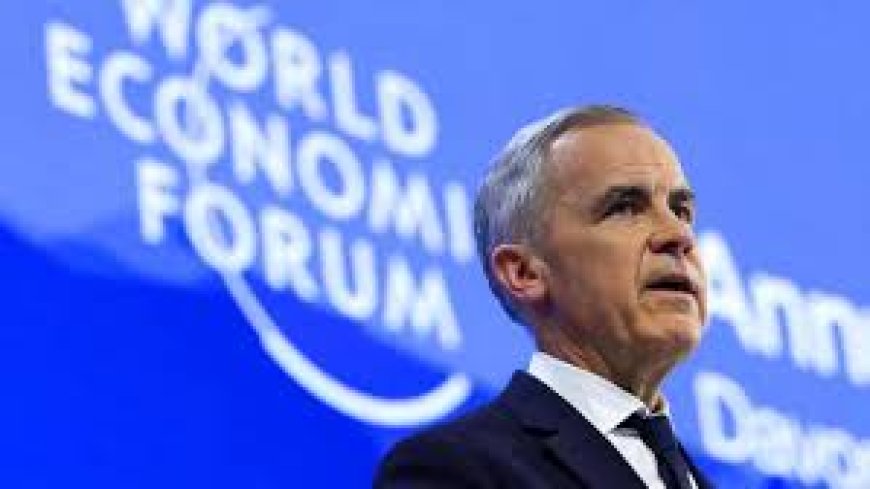
Mark Carney, Canadian Prime Minister, did not deliver a speech He performed an autopsy Not on Canada,On an era.
By Chris Agbedo
Mark Carney, Canadian Prime Minister, did not deliver a speech.
He performed an autopsy.
Not on Canada.
On an era.
He named the corpse carefully: the rules-based international order.
Not wounded.
Not wobbling.
Broken.
He avoided diplomatic perfume. No incense of multilateral nostalgia. No recycled hymns about global cooperation. He chose instead a parable, borrowed from Václav Havel.
The greengrocer.
Small shop. Small life. Big lie.
Every morning he hangs a sign in his window: Workers of the world, unite!
He does not believe it.
Nobody believes it.
But he hangs it anyway.
To avoid trouble.
To signal obedience.
To survive.
Havel called this ‘living within a lie’.
Carney’s argument is brutal in its elegance; nations have become that greengrocer.
The sign has changed. The lie has new grammar: ‘Rules-based international order’!
Displayed everywhere. Believed by few.
Canada, Carney says, is taking its sign down.
That gesture, more than defence budgets, trade corridors, or AI strategies, is the real announcement.
It is a declaration that the old theatre is closing.
The burial of a convenient fiction
For three decades, the world rehearsed a pleasant story.
Power had learned manners; empires had acquired etiquette; law had finally grown teeth strong enough to bite tanks.
But the script always had footnotes.
Rules existed.
Exemptions multiplied.
Trade promised mutual gain.
It delivered asymmetric dependence.
Institutions rose like cathedrals - the WTO, the UN, climate summits with their alphabet of hope - but faith thinned beneath the marble.
Carney says the quiet part aloud: the bargain no longer works.
Global integration has become strategic exposure.
Supply chains are no longer arteries; they are pressure points.
Finance has discovered its talent for punishment.
Tariffs have learned to speak the dialect of war.
This is not a transition.
It is rupture.
A world splitting along lines of leverage.
Middle powers, waking.
Canada is not a superpower. It does not pretend to be. It speaks instead for the in-between states - too large to be ignored, too small to dominate, too exposed to gamble on innocence.
These are the countries that built prosperity under umbrellas stitched elsewhere.
Now the rain falls sideways.
Carney proposes what he calls values-based realism: principle without naivety, pragmatism without surrender.
Values, but armed.
Morality, but industrialised.
Human rights, supported by ports, pipelines, patents, and production lines.
Hence the new arithmetic: defence budgets doubled.
Energy securitised.
AI nationalised.
Critical minerals counted like ammunition.
Trade partnerships multiplied like insurance policies.
No permanent friendships.
No eternal enemies.
Only layered options.
Geopolitics after romance: strategic cohabitation.
The table and the menu
Then comes the sentence that should echo far beyond Ottawa: ‘If you are not at the table, you are on the menu’.
It is not rhetoric. It is diagnosis.
Modern power does not always invade.
It audits.
It does not always occupy.
It rates.
It does not always conquer.
It integrates, until integration tightens into control.
Who owns the shipping insurance?
Who clears the transactions?
Who controls standards, satellites, software, spare parts?
This is where sovereignty now lives: in infrastructure, not anthems.
Middle powers are organising to avoid being served.
And Africa?
*A continent essential, not sovereign*
Africa does not appear in Carney’s speech.
That absence is loud.
In the new geopolitics, the continent is visible as terrain, not architect: minerals, markets, manpower, migration statistics.
Lithium sleeping in red soil.
Cobalt stitched into batteries elsewhere.
Gas floating under restless seas.
Youth swelling in cities wired to foreign platforms.
Africa is indispensable.
But not decisive.
Carney’s world makes this sharper, not softer.
When institutions weaken, small states lose their megaphones.
When rules blur, contracts replace constitutions.
When integration becomes weaponry, the least diversified economies bleed first.
The danger is not recolonisation by flag.
It is recolonisation by spreadsheet.
By debt schedules.
By extraction licences.
By technology standards written in rooms Africa does not enter.
By infrastructure whose ownership clauses age better than the concrete.
Nigeria’s examination
Nigeria should be a middle power.
Population: continental gravity.
Resources: geological obscenity.
Location: hinge of West Africa.
Culture: soft power factory.
Military: regional reference point.
Yet, Nigeria behaves like a small state rehearsing large slogans.
It negotiates alone.
Borrows alone.
Exports alone.
Crashes alone.
Its ports compete with its ports.
Its neighbours become rivals for scraps.
Its trade policy speaks national pride, not continental strategy.
The African Continental Free Trade Area sits politely on paper. At borders, suspicion still collects tolls.
Nigeria exports crude oil and imports dignity refined elsewhere.
Carney’s doctrine says middle powers must combine or be consumed.
Nigeria chooses solitude.
It calls this sovereignty.
It is theatre.
The performance of independence under conditions of deep dependence.
The sign remains in the window: Giant of Africa! Strategic partner to all! Leader of the Black world!
No customer believes it.
The lie we still decorate
Havel warned that systems survive because ordinary people help them pretend.
Africa has perfected this art.
Our lies are durable:
That exporting raw materials equals development.
That neutrality equals safety.
That foreign capital is always partnership.
That speeches substitute for leverage.
Nigeria’s private collection:
That oil is power.
That population is influence.
That poverty is accidental.
Canada removes its sign.
Nigeria dusts its own.
Autonomy or ornament?
Strategic autonomy is the new religion!
Feed yourself; fuel yourself; defend yourself; finance yourself.
Africa cannot yet perform this miracle alone.
But it can perform a lesser, truer one: aggregation.
Combine markets.
Synchronise standards.
Pool defence production.
Coordinate mineral policy.
Negotiate as blocs, not beggars.
Middle powers are learning the mathematics of clusters.
Africa still practices the poetry of solo acts.
In a world reorganising into fortresses, soloists become quarries.
What Carney did not say, but meant
Canada is building leverage.
Nigeria is debating petrol.
Canada is stockpiling options.
Nigeria is stockpiling excuses.
Carney’s speech is not anti-Africa.
It is worse.
It is indifferent.
Indifference is geopolitics without anesthesia.
The greengrocer’s final lesson
The old order is not returning.
That is not tragedy.
It is weather.
The tragedy is pretending otherwise.
Havel’s greengrocer believed survival required silence.
Carney says survival now requires truth.
Remove the sign.
Name the system.
Build power where sermons once stood.
Canada has taken its sign down.
Nigeria is still rearranging its shop window.
And the market has already changed its rules.
What's Your Reaction?