

















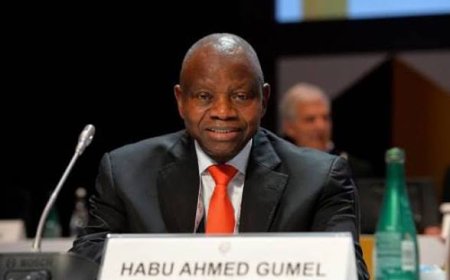




An Open Letter To The APC National Chairman, Prof Nentawe Yilwatda
Why The APC Must Publicly Repudiate Sheik Sani Yahaya Jingir's Statement
By Jonathan Ishaku
Dear Professor Nentawe Yilwatda,
Why The APC Must Publicly Repudiate Sheik Sani Yahaya Jingir's Statement
Enough has probably been written about the disturbing religious intervention attributed to Sheikh Sani Yahaya Jingir at the mass wedding ceremony in Kano over the weekend. Reactions have come from different parts of the country and, significantly, from voices within both the Muslim and Christian communities.
That breadth of concern should tell us something important. The issue is no longer merely what one cleric said at one gathering. It is about the kind of political culture Nigeria wants to carry into the 2027 general elections.
It is for this reason that I believe the All Progressives Congress, APC, under your leadership, should publicly and unequivocally distance itself from any attempt to turn the 2027 presidential contest into a religious confrontation.
This is particularly necessary because of the political transformation that has taken place within the APC itself.
From A Controversial Ticket To A Broader Political coalition
The APC that entered the 2023 elections carried considerable political baggage. Its Muslim-Muslim presidential ticket generated deep anxiety, especially among Christians and minority communities who feared that it represented not merely electoral arithmetic but the possible institutionalisation of religious exclusion.
Whatever arguments were advanced in defence of that ticket, the election itself was intensely contested and the religious composition of the ticket became one of its greatest political liabilities.
Three years later, the political landscape has changed considerably.
President Bola Ahmed Tinubu and the party leadership have worked to broaden the APC's national coalition. Under your chairmanship in particular, the party has sought to reposition itself beyond the religious and sectional calculations that dominated much of the politics surrounding 2023.
The movement of governors, legislators and political figures from opposition parties into the APC has undeniably expanded the party's geographical and political reach. Whether one welcomes or worries about such dominance, the important point is that the APC now presents itself not as the political property of a particular religion, region or ethnic bloc, but as a broad national platform.
That transformation should be protected.
Indeed, I would describe the larger political transition taking place in Nigeria as part of a post-hegemonic moment: a gradual movement away from inherited assumptions that political power belongs naturally to particular regions, religious communities or established political oligarchies. Democratic power should increasingly rest on persuasion, performance, coalition-building and the freely expressed consent of citizens—not inherited entitlement.
If that is the Nigeria we are trying to build, then no religious leader should be permitted to drag the governing party backwards.
The Economic Context
This political transformation has occurred alongside one of the most consequential economic reform programmes Nigeria has attempted in decades.
The Tinubu administration's removal of the petrol subsidy, reform of the foreign-exchange regime, fiscal restructuring and tighter monetary environment imposed enormous short-term costs on ordinary Nigerians. Those hardships should neither be denied nor trivialised.
Yet the underlying objective—to correct long-standing distortions in public finance, foreign exchange and investment—is increasingly recognised internationally. In its June 2026 assessment, the IMF said Nigeria's reforms had produced improved macroeconomic outcomes and greater resilience, while simultaneously warning that poverty, food insecurity and the cost of living remained serious challenges. It projected economic growth of about 4.1 per cent for 2026.
The continuing Iran conflict has made that difficult adjustment considerably harder. Higher crude prices can improve Nigeria's export receipts and government revenues, but disruptions in international energy markets also feed directly into domestic transport, fuel and food costs. Current tensions around the Strait of Hormuz continue to place upward pressure on global crude prices.
So this is hardly the moment to introduce unnecessary religious instability into an economy already managing difficult domestic reforms and external shocks.
The Security Question
There has also been a more aggressive federal posture against terrorism, banditry and kidnapping.
The insecurity has certainly not disappeared. Nigerians continue to suffer terrible attacks, abductions and displacement, and no government should claim victory while citizens remain unsafe.
But there have also been significant operational successes. In recent days alone, Nigerian security forces rescued more than 300 hostages in a major operation around Kainji Lake National Park, while the Army separately rescued 33 abducted travellers in Zamfara.
The Federal Government says its broader strategy now combines military operations with intelligence coordination, technology, regional cooperation and socioeconomic measures.
This matters because terrorism, banditry and sectarian violence flourish where identity is weaponised. A government fighting extremists in the forests cannot afford ambiguity when extremist or intolerant rhetoric enters the political arena.
Then Came Sheik Jingir
It is against this background that Sheikh Sani Yahaya Jingir's intervention becomes particularly troubling.é³
His rhetoric belongs to another political era—an era when religious mobilisation could be employed as electoral leverage; when citizens could be divided into believers and unbelievers for political purposes; and when politicians sometimes calculated that the easiest road to power was through the pulpit rather than through policies and performance.
That politics is dangerous.
It is also increasingly anachronistic.
If the APC believes that its record in government and its widening national coalition justify another mandate in 2027, then it does not require religious intimidation, sectarian appeals or the humiliation of Christians—or indeed adherents of any other faith—to win an election.
A governing party confident of its achievements should campaign on its record.
Professor Yilwatda, Your Own Words Provide The Answer
The irony could hardly be more striking.
On August 11, you participated in the international conference organised by JIBWIS in collaboration with the Muslim World League under the profoundly appropriate theme:“Diversity and Social Peace: A Partnership for a Promising Future.”
Your message at that gathering (your Facebook, August 11, '26) represented almost the philosophical opposite of the sectarian politics now causing controversy.
You spoke of growing up in Yobe State as the son of a Christian pastor and witnessing the friendship between your father and the Chief Imam of Nguru—two men separated by faith but united by neighbourliness and humanity.
You also recalled witnessing the darker alternative in Plateau State: suspicion, conflict, displacement, destruction and loss of innocent lives.
Most importantly, you posed questions every Nigerian politician and religious leader should contemplate:
When did our differences become reasons to fear one another? When did being Christian or Muslim become more important than being Nigerian? And when did ethnic identity become more powerful than our shared humanity?
You went further and declared that political leaders must never weaponise religion or ethnicity for temporary political advantage.
That principle cannot apply only to politicians.
It must equally apply to influential clerics whose pronouncements are capable of shaping political behaviour.
Your declaration that “religious difference does not have to produce human distance” offers precisely the philosophical answer Nigeria needs today.
The contrast could therefore hardly be clearer: one vision treats religious diversity as something to be managed through mutual respect and common citizenship; the other risks turning religious identity into an instrument of political mobilisation.
The APC must choose which vision represents it.
This Is Also, About Muslim Sensibilities
The party's response should not be framed merely as an attempt to reassure Christians. That would miss the larger point.
Millions of Nigerian Muslims reject religious intolerance. Millions live, work, trade and raise families peacefully alongside Christians. They do not wish their religion to become an instrument of partisan coercion, nor should the excesses of an individual preacher be allowed to define mainstream Islam.
Indeed, one of the strongest repudiations of sectarian politics would be for Muslim political leaders themselves to insist that Islam should not be reduced to an electoral weapon.
The issue, therefore, is not Christians versus Muslims. It is tolerance versus intolerance; citizenship versus sectarianism; democratic persuasion versus religious coercion.
Silence Can Create The Wrong Impression
This is why the APC should speak. A clear statement would not amount to an attack on Sheikh Jingir's right to religious expression. Neither would it require the party to enter into theological argument with him.
The APC merely needs to establish its own democratic boundary:
No Nigerian should be demeaned, politically disadvantaged or treated as a lesser citizen because of his or her religion. No political party should seek electoral advantage by setting one faith community against another. And the APC does not endorse rhetoric that contradicts these principles.
Such a declaration would accomplish several things simultaneously.
It would reassure Christians who supported President Tinubu in 2023 despite their reservations about the same-faith ticket. It would reassure moderate Muslims who reject sectarian politics. It would strengthen the credibility of your own message at the JIBWIS–Muslim World League conference. And, importantly, it would deny extremists of every persuasion the opportunity to define the approaching election in religious terms.
The Muslim- Muslim Ticket No Longer Needs A Religious Defence
There is another important lesson here.
The strongest defence of the Tinubu-Shettima ticket today should no longer be that it is a Muslim-Muslim ticket.
Its defence should be that it is the ticket of an incumbent administration asking Nigerians to judge it by its record.
If the government has stabilised the macroeconomic framework, let Nigerians judge it on that.
If it has improved revenue, investment and economic management, let Nigerians judge it on that.
If it has fought terrorism and banditry more effectively, let Nigerians judge it on that.
If it has widened political participation and moved Nigeria further away from inherited structures of sectional privilege, let Nigerians judge it on that.
And where it has failed, let Nigerians equally judge it on those failures.
That is democracy.
Once performance becomes the argument, religion loses its usefulness as an electoral weapon.The appropriate slogan is therefore not that Muslims must defend a Muslim ticket or Christians must resist one. It is the far simpler democratic proposition: do not change a winning team—if Nigerians themselves conclude that the team has indeed won.
A Historic Opportunity
Professor Yilwatda, you occupy an unusual position in Nigerian politics.
You are a Christian leading a governing party whose President and Vice-President are Muslims. Your own personal story connects the predominantly Muslim North-East with the religiously diverse and conflict-scarred Middle Belt. You therefore understand, perhaps better than many political leaders, both the beauty of peaceful coexistence and the terrible consequences of sectarian mobilisation.
That gives you a special responsibility.
The APC should use this moment not merely to distance itself from one controversial statement, but to establish a principle for the 2027 campaign:
Religion must never again become Nigeria's shortcut to political power.
Let churches preach Christianity.
Let mosques preach Islam.
Let politicians preach programmes.
And let Nigerians—Muslim, Christian, traditionalist or otherwise—decide who governs them as equal citizens of one republic.
The political transformation presently taking place in Nigeria will remain incomplete if the country merely replaces one form of political hegemony with another. A genuinely post-hegemonic Nigeria must reject both inherited sectional entitlement and religious majoritarianism.
The governing party should therefore say clearly that the future belongs neither to Christian domination nor Muslim domination, neither North nor South, neither majority nor minority.
It belongs to democratic citizenship.
Your own words at the Abuja conference provide an appropriate compass: Nigeria must choose dialogue over confrontation, justice over vengeance, humanity over identity.
The APC should now demonstrate that those were more than conference words.
Repudiate sectarian political rhetoric wherever it comes from. Reassure Christians. Reassure Muslims. Defend equal citizenship. And make 2027 a contest of ideas, competence and performance—not a census of faiths.
That would not weaken the APC.
It would demonstrate that the party has finally acquired the confidence to say to Nigerians:
We do not need your religion to win your vote. We need to earn your trust.
And that may ultimately prove to be one of the most important achievements of Nigeria's emerging post-hegemonic democracy. .
Jonathan Ishaku
What's Your Reaction?