


























2027 Elections: Peter Obi's Call and Tinubu's Dilemma: Accountability Cannot Be Noble Under Jonathan and Childish Under Tinubu
Political hypocrisy often reveals itself not in what leaders say, but in what they suddenly stop believing once power changes hands.
By Maazi Tochukwu Ezeoke
Political hypocrisy often reveals itself not in what leaders say, but in what they suddenly stop believing once power changes hands.
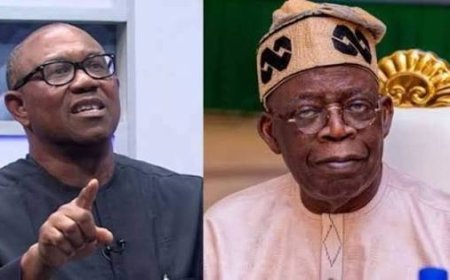
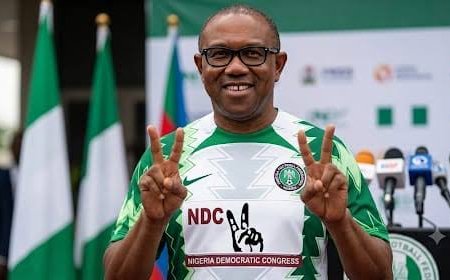
That is why the controversy surrounding Peter Obi's recent call for President Bola Ahmed Tinubu to resign is not fundamentally about resignation. It is about something far more important: whether political accountability in Nigeria is a principle or merely a weapon deployed against opponents.
The Presidency's response, delivered through presidential spokesman Bayo Onanuga, was swift and dismissive. Obi's position was described as "childish," "illogical," and evidence of a misunderstanding of the distinction between Britain's parliamentary system and Nigeria's presidential democracy.
Yet this rebuttal, while politically convenient, avoids the central issue raised by Obi. The question before Nigerians is not whether President Tinubu is constitutionally obliged to resign. The question is whether a leader who campaigned on specific promises should be held accountable when those promises remain largely unfulfilled.
Indeed, the irony of the current debate lies in the fact that few politicians have historically championed the doctrine of accountability more aggressively than Bola Ahmed Tinubu himself.
During the administration of President Goodluck Jonathan, Tinubu repeatedly accused the government of failing Nigerians. Following the abduction of the Chibok schoolgirls in 2014, he argued that Jonathan's government had demonstrated incompetence in its primary constitutional duty of protecting lives and property. At various moments during that period, Tinubu and the then-opposition APC mounted relentless criticism of Jonathan's handling of insecurity, economic stagnation, corruption, and governance failures.
More significantly, Tinubu frequently referenced political cultures in advanced democracies where leaders accepted responsibility for failures. The argument was straightforward: leadership carries consequences. Public office is a trust, not an entitlement.
At the time, many Nigerians agreed.
Today, Peter Obi has advanced a similar argument. His contention is that worsening insecurity, deepening economic hardship, persistent energy challenges, and declining living standards constitute sufficient grounds for the President to accept political responsibility.
One may disagree with Obi's conclusion. One may argue that Tinubu deserves more time. One may point to ongoing reforms whose benefits have yet to materialise.
These are legitimate counterarguments.
What is difficult to defend, however, is the notion that calls for accountability were noble under Jonathan but become "childish" under Tinubu.
Political principles cannot be subject to electoral convenience.
If insecurity justified demands for presidential responsibility in 2014, it cannot suddenly become an irrelevant metric in 2026.
If economic hardship was unacceptable under Jonathan, it cannot become acceptable under Tinubu.
If Nigerians were encouraged to judge governments by outcomes rather than intentions, they retain that right irrespective of who occupies Aso Rock.
The Presidency's attempt to reduce the debate to constitutional technicalities therefore misses the point entirely.
No serious observer believes Britain and Nigeria operate identical political systems. In Britain, a Prime Minister may lose the confidence of Parliament and be replaced without a general election. Nigeria's constitutional framework provides a fixed presidential term.
Peter Obi is undoubtedly aware of this distinction.
His argument is not legal. It is moral and political.
He is asking whether Nigeria should aspire to a political culture where leaders voluntarily accept responsibility when governance outcomes fall dramatically below public expectations.
This is hardly a radical proposition.
In mature democracies, accountability extends beyond constitutional requirements. Leaders often resign because they recognise that public confidence is the foundation of democratic legitimacy. The resignation itself is less important than the principle it reinforces: that no public official is bigger than the office they hold.
Nigeria's democratic challenge has never been a shortage of elections. It has been a shortage of accountability between elections.
Governments routinely inherit blame but rarely accept responsibility. Failures are attributed to predecessors, global circumstances, sabotage, opposition forces, or unforeseen events. Successes, however, are claimed immediately and exclusively.
The result is a political culture in which power is eagerly embraced but responsibility is endlessly deferred.
This is why the Presidency's personal attacks on Obi are ultimately unpersuasive. Whether Obi is right or wrong is secondary. What matters is whether the concerns he raises reflect realities experienced by ordinary Nigerians.
The average citizen is less interested in constitutional theory than in practical outcomes.
Can they afford food? Are their communities secure. Is electricity reliable?
Are jobs available. Is their standard of living improving?
These questions constitute the true report card of any administration.
President Tinubu himself invited such scrutiny during the 2023 campaign. He promised economic revival, improved security, stable electricity, and better living conditions. He sought office on the strength of those commitments.
Democracy requires that citizens periodically assess whether those commitments are being fulfilled.
That is not sedition. That is not anti-democratic. That is democracy itself.
Ultimately, the significance of Peter Obi's intervention lies not in whether President Tinubu resigns. He almost certainly will not, nor is there any constitutional mechanism requiring him to do so on the basis of public dissatisfaction alone.
The significance lies in the larger principle at stake. A democracy cannot thrive when accountability is demanded only of opponents and suspended for allies.
A political culture cannot mature when standards change according to who holds power.
And a nation cannot progress when leaders are permitted to forget the arguments that brought them to office.
The most compelling response to Peter Obi's challenge is therefore not outrage, insults, or constitutional semantics.
It is performance. For governments, results remain the most powerful rebuttal to criticism. Everything else is merely rhetoric.
Tochukwu Ezeoke (@MaaziEzeoke), is the headmaster, The Village Boys Movement.
What's Your Reaction?