






































The Pulpit, the Crown, and the Sacred Anathema
In the delicate interplay between faith and statehood, the pulpit has long served as both a mirror to power and a lightning rod for societal discontent.
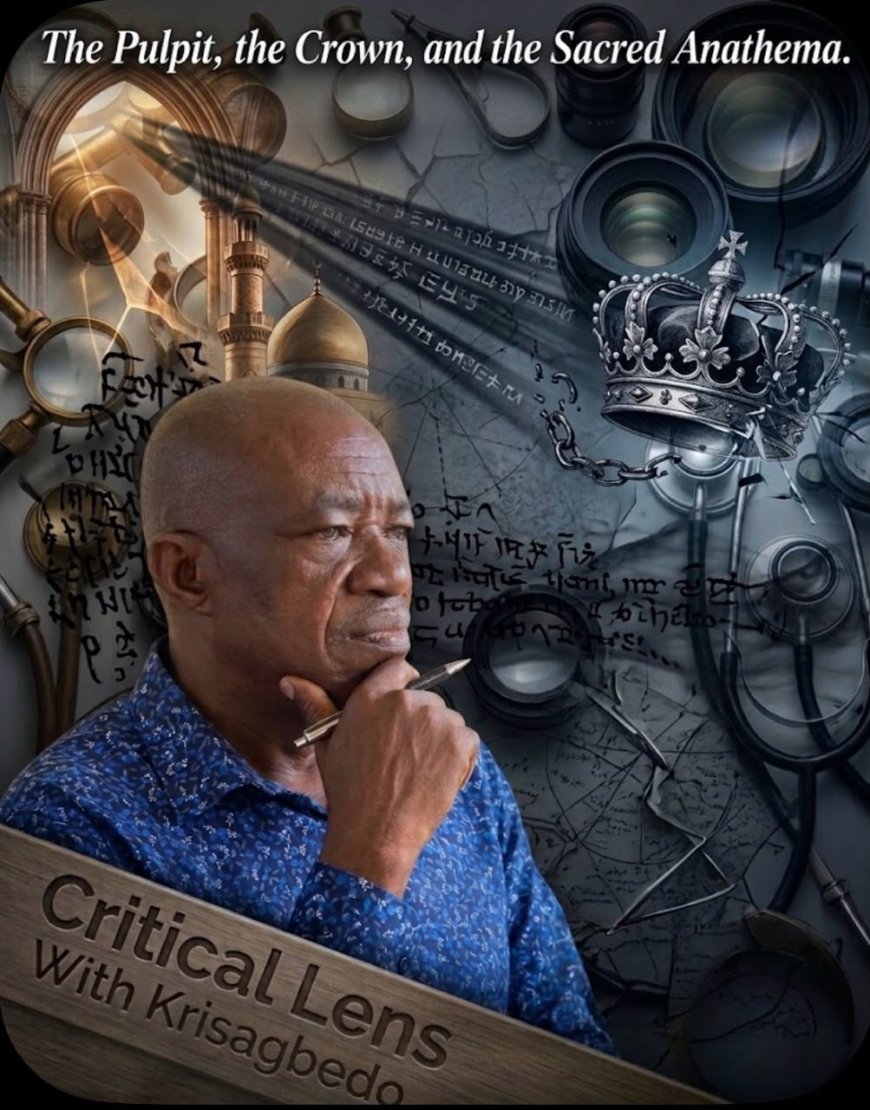
By Prof Chris Agbedo
In the delicate interplay between faith and statehood, the pulpit has long served as both a mirror to power and a lightning rod for societal discontent. When a northern Islamic cleric stands before his congregation during the sacred rites of the Friday Khutbah to summon heaven’s wrath upon President Bola Tinubu, the spectacle transcends a transient political skirmish.
It becomes a profound, troubling rupture in the unspoken contract of civic and spiritual dialogue. To witness a sacred space transformed into an arena of ritual excommunication is to observe the perilous juncture where theological zeal collides with temporal governance.
Power, by its immutable nature, invites judgment. From the pharaohs of antiquity to modern constitutional presidents, those who hold the reins of statecraft step onto a stage illuminated by the unforgiving glare of public scrutiny. However, when the critique of governance shifts from the analytical to the apocalyptic, when the instrument of accountability is replaced by the decree of divine condemnation, the boundary between righteous indignation and incendiary rhetoric dissolves.
To label a sitting sovereign an "infidel" and invoke divine curses from holy ground is to swap the surgical scalpel of constructive critique for the sledgehammer of dogmatic fervour. Such language does not illuminate the shortcomings of policy, nor does it elevate the condition of the governed; it merely darkens the public square, reducing complex socio-economic realities to an existential conflict between the blessed and the damned.
Historically, the collision between the altar and the throne has shaped the destiny of empires, often with devastating consequences.
When Thomas Becket, the Archbishop of Canterbury, clashed with King Henry II in twelfth-century England, the collision between ecclesiastical authority and royal prerogative ended in blood on the cathedral stones, dividing a kingdom and scarring its soul. Centuries earlier, the prophet Nathan confronted King David over his moral failings, yet Nathan did not resort to cursing the monarch or delegitimizing his realm; he employed allegory, truth, and moral clarity to awaken the royal conscience. The distinction is vital: Nathan sought the restoration of justice, whereas the invocation of anathemas seeks the destruction of the adversary.
When religious authority abandons the prophetic tradition of persuasive truth in favour of sacred malice, it undermines its own moral authority, weaponising faith in a manner that historically breeds fanaticism rather than reform.
Classical literature and philosophy offer cautionary tales regarding the ruinous nature of unbridled rhetoric in times of political distress. In Sophocles’ Antigone, the clash between Creon’s unyielding state decrees and the sacred, unwritten laws invoked by Antigone illustrates the tragic paralysis that ensues when compromise is banished from the realm. Yet, even in the depths of that Greek tragedy, the chorus warns against hubris; i.e., the blind passion that mistakes personal or sectarian fury for divine will. When a cleric declares that a leader's presence desecrates holy ground, as seen in the references to Mecca, he echoes the tragic hubris of ancient demagogues who sought to divide communities along lines of absolute purity and irredeemable corruption. In a multi-ethnic, multi-religious republic, such rhetoric acts as a solvent upon the fragile bonds of national cohesion.
Conversely, the state and its custodians must not view such pulpit outbursts in a vacuum. A curse uttered from the sanctuary is rarely an isolated spark; it is frequently the visible smoke rising from a subterranean fire of popular distress, economic hardship, and widespread disillusionment. When the body politic suffers under the weight of inflation, insecurity, and social precarity, the pulpit becomes the mouthpiece for the voiceless, albeit sometimes in distorted forms. While the cleric’s method remains toxic, the visceral resonance of his words among a suffering populace demands dispassionate introspection from the throne.
History instructs us that crowns, which ignore the murmurs of the sanctuary risk mistaking quiet desperation for enduring consent. When King Louis XVI turned a deaf ear to the grievances articulated by both the Third Estate and the lower clergy in pre-revolutionary France, he failed to realise that the rhetorical broadsides aimed at his court were symptoms of a structural collapse. A wise administration does not merely react to the hostility of its critics; it examines the soil in which such hostility takes root. Dismissing religious disaffection purely as political subversion ignores the deep-seated anxieties of citizens who feel abandoned by the social contract.
Political philosophy, from Niccolò Machiavelli to Hannah Arendt, underscores that legitimacy cannot be sustained by executive power alone, nor can civic peace survive if public discourse degenerates into total war. Machiavelli observed in The Discourses that republics, which permit their religious institutions to become engines of factional hatred invite internal ruin. Arendt, reflecting on the conditions of modern politics, argued that true power arises only when human beings act together through speech and persuasion, whereas violence and condemnation emerge when speech loses its meaning. When religious leaders substitute reasoned argumentation with ritual curses, they abdicate their role as moral guides and become partisans in a low-intensity conflict of words.
Democracy thrives neither on blind reverence for authority nor on sanctified malice disguised as piety. It demands an elevated, cerebral civic language, one where those in power are held to account not by religious decrees, but by the measurable metrics of justice, equity, transparent governance, and human dignity.
The pulpit holds a sacred trust: to comfort the afflicted, to speak truth to power, and to act as a conscience to the nation. Nonetheless, that trust is betrayed when the pulpit is converted into an artillery battery firing spiritual missiles into the civic domain.
If the state is to heal its fractures and navigate the turbulent waters of modern nationhood, both the ruler and the preacher must recalibrate their solemn duties. The sovereign must govern with empathy, wisdom, and an acute awareness of the people's pain, ensuring that policy serves the common good rather than political expediency. Simultaneously, the cleric must return to the higher calling of temperance, intellectual rigour, and spiritual depth, recognising that light, not heat, is what illuminates the path toward national redemption. Only through such a mutual commitment to elevated discourse can the Nigerian state escape the tragic cycle where the crown rules without empathy and the pulpit preaches without grace.
What's Your Reaction?