



















Jonathan Presents Another Contentious Book On Buhari To Public November 17
Former President Goodluck Jonathan is to present a new three-volume authorised biography of late ex- President Muhammadu Buhari, in a bid to set the records straight and remove negative perceptions and remarks about his character and leadership ability, in Abuja on November 17, 2026, with the ex- President of Niger Republic, Mahamnadou Issoufou, as chairman of the occasion.
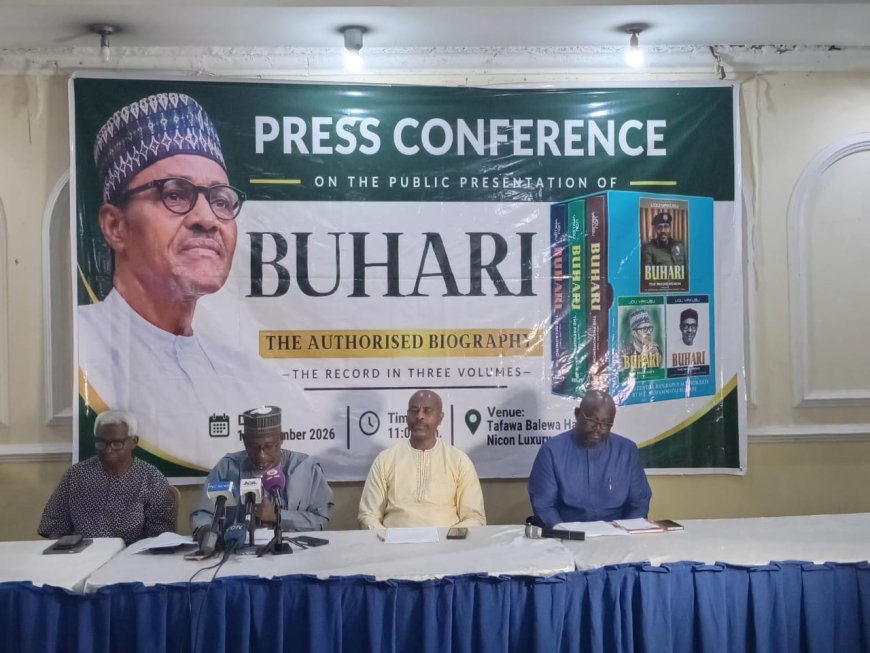
Former President Good uck Jonathan is to present a new three-volume authorised biography of late ex- President Muhammadu Buhari, in a bid to set the records straight and remove negative perceptions and remarks about his character and leadership ability, in Abuja on November 17, 2026, with the ex- President of Niger Republic, Mahamnadou Issoufou, as chairman of the occasion.
The book, titled Buhari: The Authorised Biography, on Buhari was unveiled on Wednesday, November 11, 2026, at a news conference at the Tafawa Balewa Hall, NICON Luxury Hotel, Abuja, where the author and Chief Biographer, Dr. Udu Yakubu, explained the motives behind the making of the work.
Yakubu said the biography was the result of more than two years of sustained research, including interviewing, writing, editing, checking and revisions, though the real beginning reached much further back, because no serious biography of Buhari could begin simply with the decision to write the book.
According to him, Buhari's public life crossed military and democratic eras, war and reconstruction, petroleum prosperity and economic crisis, military rule and democratic contest, opposition politics and presidential power, appearing in different forms before successive generations of Nigerians.
Yakubu further said that different generations, had different ideas and perceptions about Buhari noting that in one generation, he was the young military officer; to another, the austere, severe and controversial military Head of State of 1983-85; and yet to another, the persistent opposition candidate, who refused to disappear and giveup the struggle for power even after repeated defeats; and to millions of younger Nigerians, he was the civilian President, who governed from 2015 to 2023.
His words, "All these Buharis belonged to the same life, the same person. The challenge was to understand how, asking how the boy from Daura became the soldier, what survived when he entered democratic politics, why a man removed from power in 1985 returned three decades later through the ballot box, and what happened when the ideals of the opposition candidate met the burdens of governing Nigeria."
Yakubu further said that those questions, could not be answered adequately in one volume, hence the three-volume structure.
"Volume One, The Phenomenon, follows Buhari from ancestry and childhood through military formation, the Civil War, governorship, petroleum administration, emergence as Head of State, overthrow and detention, and the long struggle culminating in the 2015 election.
"Volume Two: His Presidency ; his government itself, examining the institutions, personalities, decisions, pressures and crises of 2015-2023, placing official intention beside public consequence, recollection beside documentary evidence, and testimony beside controversies.
"Volume Three: The Reckoning; draws together the major questions through which Buhari's legacy will continue to be assessed: security, the economy, infrastructure, anti-corruption, governance, foreign affairs, social policy, institutional reform, national cohesion and leadership itself," he added.
Yakubu stressed that though the work was authorised by President Buhari before he died, it opened doors to people, recollections and documentary trails, the authorisation did not mean surrendering judgement, as the subject had his voice while the biographer retained his independence.
He said the work lies between divided interpretations: for some, while Buhari represented discipline, restraint and incorruptibility; or rigidity, economic misjudgement and political insensitivity, for others but the book's task was not to decide in advance which Buhari should survive but to allow evidence, chronology, circumstance and consequence to do their work.
The project required listening to admirers and examining criticisms he might not have accepted, understanding the reasoning behind decisions without assuming that explanation amounted to vindication. It also required preserving tensions rather than making them disappear, from infrastructure gains and security successes or the emergence of new insecurity, anti-corruption recoveries, and difficult debates over monetary policy, debt, subsidies, poverty and unemployment.
Yakubu said where testimony conflicted, he sought corroboration; where documents existed, memory had to answer to them; and where uncertainty remained, it had to remain visible, noting that a biography does not resolve all questions of a human life.
Buhari's death, he added, changed the circumstances of the work, closing further direct questioning, but also imposed a responsibility to resist both softening judgement after death and becoming harsher because the subject could no longer respond, insisting the biography did not become a memorial work.
According to Yakubu, the volumes are not the final word on Buhari, but an argument for the serious preservation of Nigerian lives, institutions and national memory, urging Nigerians not to agree upon Buhari but to read him, examine the records, interrogate decisions and measure intention against consequences, for that is the meaning of The Reckoning: not condemnation, vindication, but accounting.
What's Your Reaction?