


















One Year After the Broken Walls Began to Rise, What Has Changed at the University of Nigeria?
Prof. Simon Ortuanya came to office promising to “rebuild the UNN” A year later, the University of Nigeria is showing visible signs of physical and institutional rebirth, but the harder test may lie ahead.
Prof. Simon Ortuanya came to office promising to “rebuild the UNN” A year later, the University of Nigeria is showing visible signs of physical and institutional rebirth, but the harder test may lie ahead.
A year ago, on August 11, 2025, Professor Simon Uchenna Ortuanya arrived at the helm of the University of Nigeria administration with a message that sounded less like an administrative slogan than a call to arms: “Arise, let us rebuild.”
His words carried the imagery of Nehemiah, the biblical prophet who returned to Jerusalem, surveyed its broken walls and mobilised his people to rebuild what had been left in ruins. Many observers saw the vision as an ambitious rallying call to rescue an institution carrying more than six decades of history, a university whose challenges include ageing infrastructure, rising student demand, pressure on academic facilities and the increasingly competitive global higher-education landscape.
One year on, the question is no longer whether anything has changed. It is how much has changed and whether the changes can continue at the current pace.
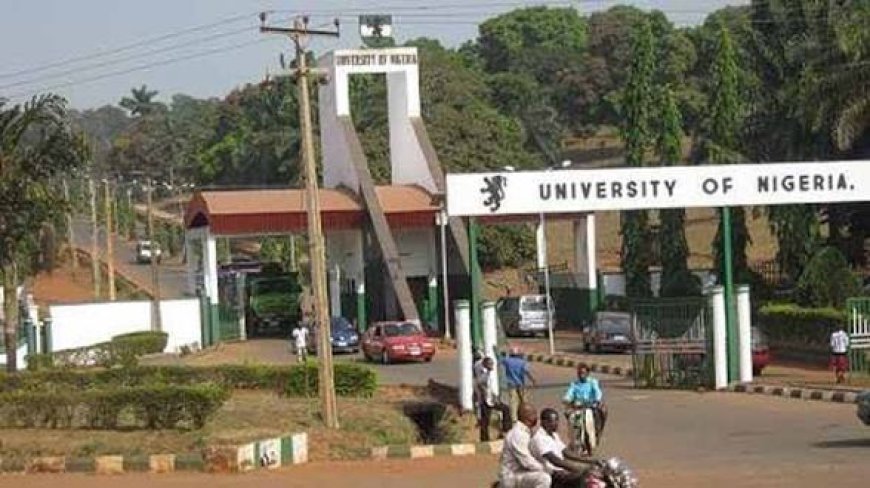
Across the campuses of the University, the transformation is increasingly difficult to miss. Roads are being reconstructed. Shanties that had become familiar features of the campus landscape have been removed. The university environment is being reshaped. A new gate now provides a more imposing entrance to the premier university. Student hostels are being renovated. New academic opportunities are emerging. International partnerships are expanding. Research infrastructure is receiving revived attention, while the university has been making strong appearances in global rankings.
But buildings, roads and rankings tell only part of the story. The more revealing measure of Prof. Ortuanya’s administration may be found in the people who live and work within its walls, and in how they describe the changes around them.
“The analogy of Prof. Ortuanya’s vision and approach to the Biblical Nehemiah is difficult to avoid,” said Mrs Ogechukwu Whyte Nwankwo, the Director of Alumni Relations Unit. Like Nehemiah, she suggested, Ortuanya appears to have approached the university as a place requiring both physical reconstruction, institutional renaissance, and psychological reimagining of its staff
Within Prof. Ortuanya’s first year, that approach has produced changes that are visible to staff, students and visitors.
For Comrade Christian Ugwuanyi, an Associate Professor of Science Education and Financial Secretary of the Academic Staff Union of Universities (ASUU), one of the notable changes has been the increased attention to institutional development. He also pointed to improved communication with stakeholders and what he described as a more goal-oriented working environment. But his assessment is not without a caveat. For him, the rebuilding project should extend beyond physical infrastructure to staff welfare and the faster resolution of administrative concerns.
Comrade Dr. Linus Akata, Chairman of the Senior Staff Association of Nigerian Universities, SSANU, UNN, and Zonal Treasurer, points to another dimension of the change, which is boosting staff morale. He cited the approval of staff promotions and the reinstatement of Christmas bonuses under Ortuanya's administration. The effect, he said, has been significant. For Comrade Akata, the university is beginning to experience a sense of recovery and optimism.
Students, too, have noticed the changes in the University, although their expectations remain high. Agba Peace Chinaza, a 200 level student of Department of Hospitality and Tourism Studies, rated Ortuanya’s administration nine out of ten, while identifying accommodation as one area where more work is still needed.
Agba’s concern brings the rebuilding project into sharper focus. For many decades now, students’ accommodation has been one of the most visible reminders of the pressures facing the university.
Ortuanya's administration began a phased rehabilitation of student hostels after assessing the scale of work required. More than five hostels are currently undergoing renovation, while new hostels are being constructed for pharmacy and nursing students at the University’s College of Medicine, Ituku-Ozalla.
Then there is the Zik's Flat. For more than a decade, the facility had become almost a symbol of institutional dilapidation. It is now receiving attention under a public-private partnership arrangement.
Meanwhile, not every change under Ortuanya is as immediately visible as a newly reconstructed road and renovated hostels. Some of the administration's most consequential moves may be taking place beyond the physical campus. Internationalisation, for example, has emerged as a significant part of the university's strategy.
Ayobami Odubiyi, Deputy Director of the ICT/Innovation Centre and Chairman of Egbe Omo Oduduwa, Nsukka, described international collaboration as one of the administration's investments that may not immediately be obvious to everyone.
Under Ortuanya, the university has strengthened collaborations with institutions and partners including Canada's University of Waterloo, Nelson Mandela University, Michigan State University, the Chinese and Taiwanese governments and Nigerian government ministries.
There are already visible fruits of the partnerships as Engr. Henry Ikemefuna Ugwu leveraged the partnership with the People’s Republic of China to secure a fully-funded Ph.D scholarship at the Hunan University, China.
For an administration that has openly declared an ambition to make the University of Nigeria the number one university in Africa, global rankings offer another way of measuring progress. Within the Ortuanya's first year, UNN recorded strong positions in many global university rankings.
The university ranked second in Nigeria in the 2026 AD Scientific Index and also emerged second in Nigeria in the 2026 Global Interdisciplinary Science Rankings released by Times Higher Education. In the inaugural 2026 QS World University Rankings for Sub-Saharan Africa, UNN was placed 19th among 260 universities.
The university also featured strongly in the 2026 Center for World University Rankings, CWUR, Global 2000 list, emerging as the second-best university in Nigeria, while the 2026 SCImago Institutions Rankings placed UNN third in Nigeria for research performance, innovation and societal impact.
Perhaps the most interesting way to assess Ortuanya's first year is to measure his actions against the university's motto: “To restore the dignity of man.”
One professor, who asked not to be named, offered a broad interpretation. Restoring dignity, the professor suggested, could mean a safer campus, a functioning road network, decent accommodation for students and staff, access to digital resources, functional laboratories for research, and ensuring that students with disabilities are not excluded from university education.
The university's recent recognition by the Joint Admissions and Matriculation Board, JAMB, for supporting blind students provides one example of that broader idea. UNN admitted 18 visually impaired students in the last admission cycle, a development that earned the institution recognition from JAMB.
The Ortuanya administration's efforts to reorganise transportation and restrict motorcycles on campus can also be viewed through that lens, although such measures naturally produced different reactions depending on who is affected by them.
For some, order and safety are worth the inconvenience of new restrictions. For others, restrictions are meaningful only if alternative transportation is affordable, reliable and available. The rolling out of the solar-powered tricycles that charges N100 satisfied the demand for alternative means of transportation.
That interaction between the current visible developments and the desire for sustainable transformation may define the next phase of Prof. Ortuanya's tenure. Observers of recent events in the University believe that the reconstructions are overdue corrections to an environment that had not always reflected the stature of Nigeria's first indigenous university.
They argue that Prof Ortanya is doing what he is expected to do as someone who bears the burden of serving as the first Vice-Chancellor from Nsukka zone and that of building a university aspiring to compete with the best institutions in Africa.
Many believe that Prof. Ortuanya's first year has proven that things can change within a short period of time. The broken walls are no longer merely being discussed, many are being rebuilt.
With one year behind Prof. Ortuanya’s five years tenure, many members of the University Community have written their verdict. For some, the verdict is one of excellence and renewed confidence. For others, it is one of cautious optimism, an acknowledgement that the rebuilding has begun, but a reminder that much remains to be done.
What's Your Reaction?